
Law firm bookkeeping looks like regular small business bookkeeping until you hit one rule: client money is not your money. Retainers, settlement funds and advanced costs belong to your clients, and state bar rules govern how you hold, track and report them. Get it wrong and a bookkeeping error becomes an ethics problem.
This guide explains how trust accounting works, the mistakes that come up most often in law firm books, and what to look for when you hand the work to someone else.
A note before we start: we’re an accounting firm, not a law firm, and this isn’t legal advice. Your state bar’s rules are the final word. In Georgia, start with Rule 1.15 of the Georgia Rules of Professional Conduct and check the State Bar of Georgia for the current requirements.
Why Law Firm Bookkeeping Is Different
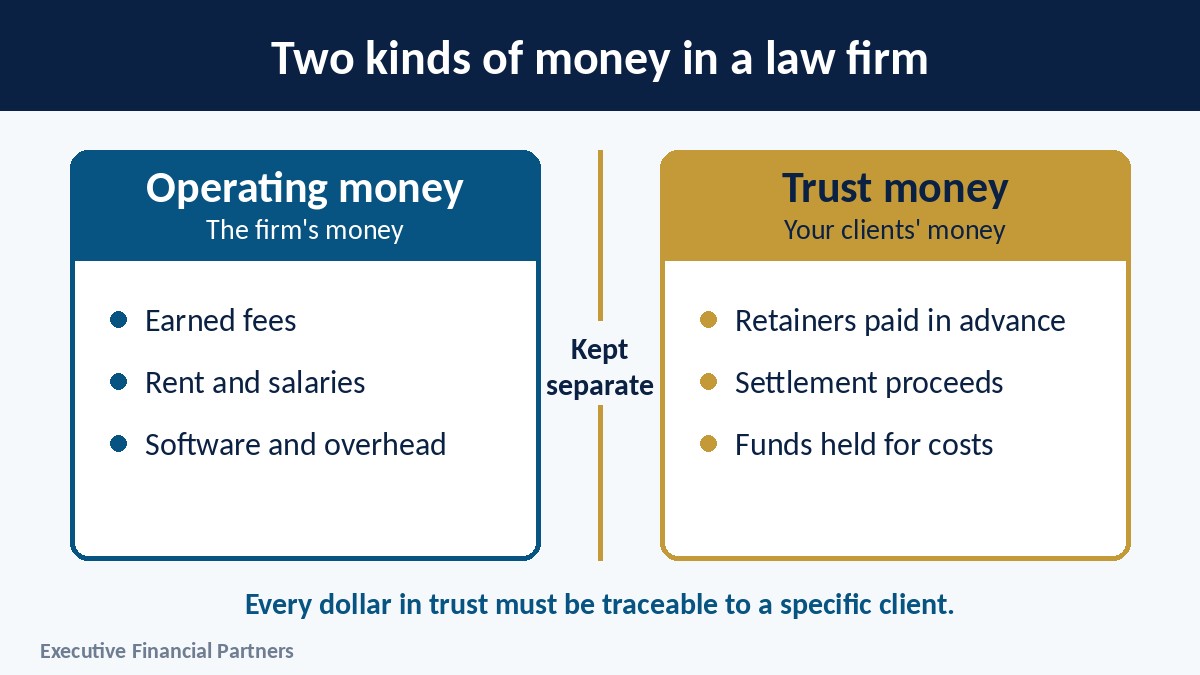
A law firm handles two kinds of money. Operating money is the firm’s: earned fees that pay rent, salaries and software. Trust money belongs to clients: retainers paid in advance, settlement proceeds, and funds held for costs. The two must stay separate, and every dollar in trust must be traceable to a specific client.
On top of that, a firm has its own financial questions. How much time is being billed but not yet invoiced? Which invoices are getting old? How much did partners take out, and was it recorded correctly? Good legal bookkeeping answers both sets of questions.
How Trust (IOLTA) Accounting Works
IOLTA stands for Interest on Lawyers’ Trust Accounts. It’s a pooled trust account used for client funds that are small in amount or held for a short time. The interest the account earns goes to a state-designated program rather than to the firm or the client. Larger sums or funds held for longer may need to go into a separate interest-bearing trust account for the client’s benefit. The details vary by state.
However your state sets it up, trust accounting usually rests on four pieces:
- A separate trust bank account, titled as a trust account, and never used to pay firm expenses.
- A ledger for every client, showing each deposit, each payment and the running balance.
- A trust journal or general ledger that records all trust activity in one place.
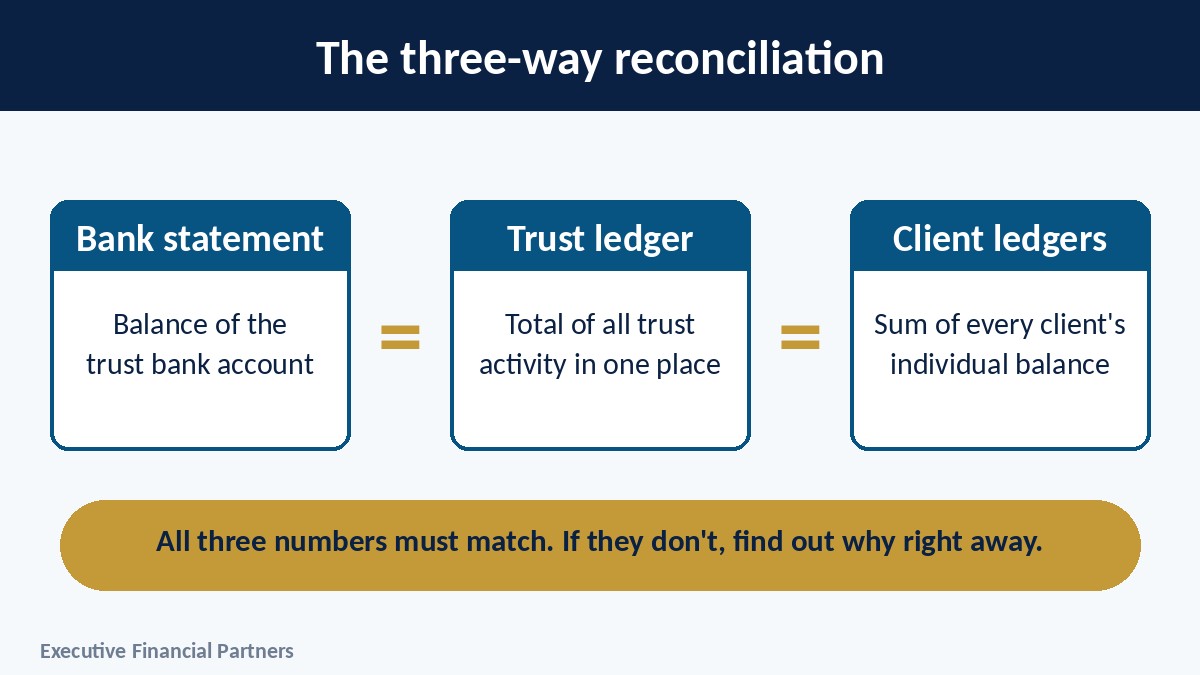
- Regular three-way reconciliation, where the bank balance, the trust ledger total and the sum of all client ledgers must agree.
If those three numbers don’t match, something is wrong, and it needs to be found and fixed right away.
Common Law Firm Bookkeeping Mistakes
Commingling Firm and Client Funds
Depositing a client’s money into the operating account, or leaving earned fees sitting in trust, mixes funds that must stay separate. It’s the most serious mistake on this list, and often the easiest to make when things get busy.
Moving Fees Out of Trust Too Early
Money in trust can generally only move to the operating account once it has been earned and the client has been billed in line with the fee agreement. Taking it out early, even by a few days, can create a compliance problem.
Letting a Client Ledger Go Negative
A negative balance on a client ledger means the firm paid something for that client with other clients’ money. Every client ledger should stay at zero or above at all times.
Skipping or Delaying the Three-Way Reconciliation
Monthly reconciliation is the standard practice, and many jurisdictions require it. Letting it slide for a quarter makes errors much harder to trace.
Losing Track of Advanced Client Costs
Filing fees, expert fees and court reporter costs paid on a client’s behalf need to be recorded to the right client and recovered properly. Costs coded to general overhead get lost.
Ignoring Unbilled Time and Aging Receivables
On the firm side, the books should show work done but not yet billed, and invoices that are aging. Without them, cash shortages come as a surprise.
Recording Partner Draws as Expenses
Owner distributions are not operating expenses. Coding them as such distorts the firm’s profit and creates problems at tax time.
Beyond Trust: The Rest of the Books
Once trust accounting is under control, the firm’s own financials need attention too. A useful monthly package for a law firm includes a profit and loss statement, a balance sheet, an aged receivables report, and a view of billed versus collected revenue.
Cash flow deserves extra care. Contingency-fee firms may go months with expenses and no income, then receive a large settlement at once. Planning for that rhythm is a financial leadership job, and it’s where a fractional controller or CFO can help once the basics are in order.
Doing It In-House or Outsourcing It
Many small firms start with an office manager, or a partner working on the books at night. It works until it doesn’t. Signs it’s time to bring in outside help:
- Month-end close is slipping, or the trust reconciliation is behind.
- Nobody on the team has formal bookkeeping training, or the time to do it right.
- Partners are spending evenings on bookkeeping instead of billable work.
- The firm is growing, adding attorneys, or opening a second office.
When you look at a law firm bookkeeper, ask whether they have experience with trust accounting, how they handle the monthly three-way reconciliation, what reports you’ll receive and when, and whether they work with your practice management software.
One important point: even when you outsource, the attorney generally remains responsible for compliance with the trust accounting rules. A good bookkeeper makes compliance much easier, but it doesn’t move the responsibility off the lawyer.
A Simple Monthly Routine
- Reconcile the trust account three ways: bank, trust ledger and client ledgers.
- Review client ledgers for negative balances and stale balances that need follow-up.
- Review transfers from trust to operating and confirm each was earned and billed.
- Close the operating books and review the financial statements.
- Review aged receivables and unbilled time.
- Send a short summary to the partners.
Frequently Asked Questions
What is an IOLTA account?
It’s a pooled trust account for client funds that are small or held briefly. The interest goes to a state-designated program rather than to the firm.
How often should a law firm reconcile its trust account?
Monthly is the common standard, and some jurisdictions require it. Check your state bar’s rule for the exact requirement.
Can a retainer go into the operating account?
In most places, advance fees and unearned retainers belong in trust until they’re earned, but rules differ depending on the type of fee agreement. Confirm with your state bar.
Can an outside bookkeeper handle trust accounting?
Yes, if they have the experience, and with attorney oversight. The firm’s responsibility for compliance stays with the attorney.
Need Help With Your Firm’s Books?
Executive Financial Partners provides accounting and bookkeeping for Atlanta law firms, and we offer fractional controller and CFO support for firms that want financial leadership on top of clean books. Learn more about our law firm accounting and bookkeeping services, or see our full accounting and bookkeeping services.
Schedule your free consultation or call us at (404) 919-7022.


